Little Republic of Apuccinia
Quick disclaimer
This page is about 90% work in progress. I’m writing it solo between my full-time, cursed bills (sigh) and a vanishing social life. But ideas never stop coming, piling up in my head day after day, sometimes good, sometimes bad…you decide. Progress is slow, but this is the part of the hobby I truly love and the project keeps growing, one piece at a time.
Support is always welcome. Thanks!
That said, instead of leaving everything empty and outdated, what follows is a first early draft: the homebrew starting point meant to show the direction of this page and, hopefully, one day become a fully playable army with a kitbashed miniature collection.
Let me introduce you to the Little Republic of Apuccinia!
FIRST DRAFT
As a proud Miraglianese at heart, I’ve always missed a truly Roman army. Sure, there are the City-States of Luccini and Remas, which echo fragments of the glorious URBE, but Tilea as a whole leans far more toward the Renaissance than toward Antiquity.
There is, however, another problem: a Roman-style army, in terms of battlefield organization, relentless expansion and a gladius-sharp mindset (or should I say forma mentis), would simply sweep the Old World aside. Tilea would be completely united!!! The Empire, Estalia and Araby reduced to vassal provinces, while even Ulthuan and Cathay would be next on the campaign list. Something like that clearly needed a nerf…the power-play-lore-decimation.
So, I changed the race. No towering warriors. No brute force. I chose a folk whose strength lies not in muscle, but in stubborn courage, unbreakable community and, of course, an impressive appetite. The Halflings…ROMAN HALFLINGS!
Small in stature, yet resolute in a world of barbarians twice their height. Victory does not come from physical might, but from a methodical discipline in doing things – whether cooking meals or waging wars, there must be order! Political charisma and drilled formations of little legionaries are incredible weapons…
Thus was born the Little Republic of Apuccinia. Whether its people come from the Moot or are native to Tilea remains open for now. Their homeland lies within the forests near the Apuccini Mountains, preserving the geography of the Old World and aligning it with a Roman-inspired history.
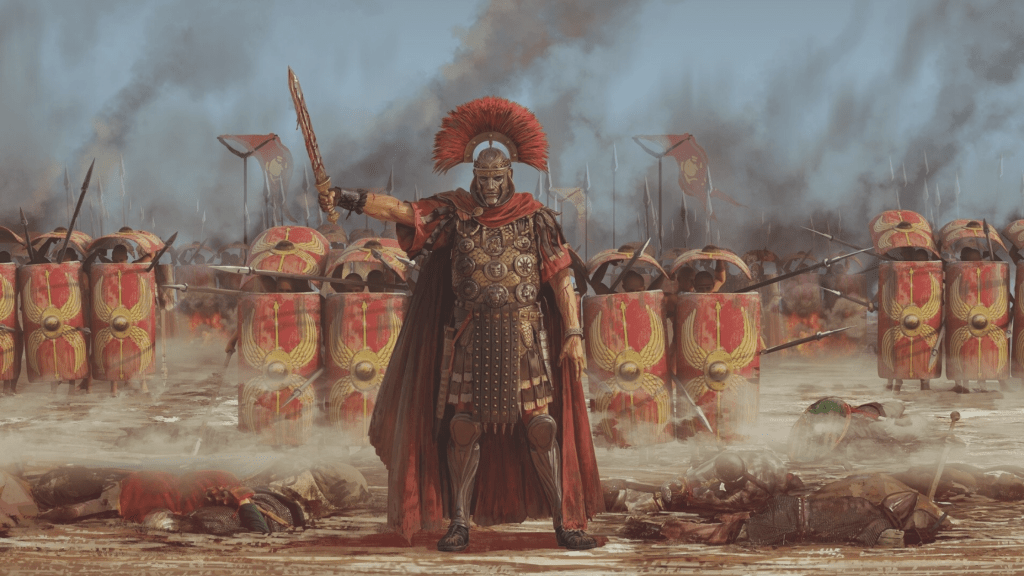
How I love the image of a Halfling dressed as a centurion or a shield-wall marching toward the Border Princes! Oh and wielding a military doctrine sharp enough to make even Karl Franz pale. Yet beneath the toga and the laws survives an older faith. The Apuccinians revere a powerful Cult of the Wolf, something ancient and almost primal. Perhaps it is a reflection of Ulric, perhaps a feral vision of Myrmidia or perhaps the two were never separate at all: divine twins, nurtured by the Great Wolf Mother. The Republic tolerates the old ways, yet never truly commands it. Within the forest shadows and the glow of ritual fires, the civil mask shatters, giving way to fur and flame, howls and traditions beyond the reach of the Senate.
This is the Little Republic of Apuccinia – small, but unyielding – surrounded by giants and ready to prove that discipline matters more than size.
LORDS
Legatus – the classic army general. A seasoned commander whose abilities revolve around Leadership. The Legatus embodies authority through structure rather than personal heroics. The hand of the Senate or the Consuls.
Pontifex – high and pragmatic eminence of the Res Publica. Rather than a spellcaster, the Pontifex is more the spiritual & civic authority. Closer in role to a Dwarf Runelord than a wizard, granting magical protection and mastery of the Ars Oratoria (supercharismatic speech). The voice of the Senate or the Consuls?
HEROES
Tribunus – if the Legatus is the general, the Tribunus is the captain. The Tribunus may serve as the Battle Standard Bearer or Vexillarius, the role sacred to the legion!!! He provides key bonuses to cohesion, formations and morale.
Consilium of Centurions – with lower individual characteristics than a Tribunus, the Consilium allows 1 to 3 Centurions to be recruited as a single Hero choice. They serve as communication hubs, attached to Core and Special units to improve the flow of orders. In this way, a highly disciplined chain of command is maintained, running from the Legatus, to the Tribunus, to the Centurions and finally down to the common legionary.
Magister Coquinario – inspired by the Paymaster of the Dogs of War and likely a mandatory inclusion in the legion. This sort of quartermaster and battle-cook oversees rations and thus morale through food. Much like the Blessing of the Lady, the army never plays in the first turn – the troops are always eating before battle – but gain a form of “caloric” Ward Save or a bonus to Strength and Toughness. May take a field kitchen as an upgrade.
Goliath Venator – the slayer of monsters, but not like his red-crested dwarf cousins. A hunter armed with sling, like in the myth of David versus Goliath or Jack the Giant Killer. Specialized in felling large foes…since almost everything towers over a Halfling. Boom Headshot = Heroic Killing Blow.
Mater Sorania – the priestess of the Wolf Cult, calling upon ancient prayers or alternatively a low-level wizard (Level 1–2). The name “Sorania” draws inspiration from the Hirpi Sorani, wolf-priests devoted to Soranus. This deity is a confused fusion (con-fusion lol) of Apollo, god of the sun, and Dis Pater, god of the underworld. True story! This theme of fire and death with wolves is absolutely fascinating! A black sun instead of a full moon to howl at? Therefore, a Mater Sorania could have access to magic from the Lores of Fire, Death and Beasts, though a custom Lore may eventually be written. Dunno…
Iron Pot Champion – winner of the bloody arena games of the Iron Pot. A crowd-favorite bruiser, fueled by pride and public adoration. A straightforward yet brutal combat Hero, built to hit hard in close combat with many equipment options from the gladiatorial schools.
Hireling Tilean Wizard – some rare concession to traditional magic, representing foreign influence or a tolerated arcane practice. This choice is still under consideration, but some form of “classic” magic is acceptable and Roman culture had no qualms about employing barbarian skills for practical purposes (aka warfare). I also like the name Mercenary Wizard or Auxiliary Wizard.
CHARACTER MOUNTS
Rooster Magnus – the obvious and inevitable choice…a giant war-rooster bred as a mount for Halflings. Very popular in the games of the Iron Pot for its loud cock-a-doodle-doo and aggressive nature. With a fluttering-flight charge, raptor-like spurs and bright colours that reflect the pride of the Apuccinian Republic, this mount simply had to be on the army list.
Hirpinian Wolf – the sacred creature halfway between a Giant Wolf and a Dire Wolf. Tied to the infernal aspects of the Wolf Cult of Sorania, these beasts have coal-black fur and ember-bright eyes – so much so that the Supreme Poet Dante Alighieri might have called them “le fiere con occhi di bragia”. Ah they have Flaming Attacks, obviously.
Lictorogre – an Ogre bodyguard inspired by the Roman lictores, serving as a living palanquin and personal guard for high-ranking figures. Oh yes, Lictors are not only terrifying Tyranid killers! This Ogre must be armed with a massive tree-trunk axe and represents brute force controlled by civic authority.
Tauriga Triumphalis – the ceremonial chariot drawn by four (FOUR I SAID) massive white oxen. A symbol of triumph and state authority, representing supremacy in both political power and military might, yet above all a devastating force upon the enemy lines.
Ara Belli – the design is inspired by the Ara Pacis of Rome (the Altar of Peace commissioned by Augustus), while the rules are based on the War Altar of Sigmar from the Empire and the Casket of Souls from the Tomb Kings. Counts as a shrine and may only be “mounted” by a Pontifex. I like the idea of a raised rostrum…why not a marble lectern that dominates the platform? Here, words become weapons, orations and proclamations inspire the troops.
CORE UNITS
Legionaries – the backbone of the Roman and thus Apuccinian army. Likely mandatory, well-armoured and well-disciplined. When equipped with scuta (tower shields), they can form the iconic testudo formation. I desperately want to see this on the tabletop…
Sagitta-Legionaries – the auxiliary and ranged counterpart to the legionaries. Still well-armoured and well-disciplined, but equipped with short bows. The option to take crossbows as an expensive upgrade is appealing and actually not that far off historically.
Hastati – as the Latin name suggests, they are those armed with the hasta: spears, javelins or even pikes. Within a cohort, they are the youngest soldiers, yet the first line of battle. While they may not have the Weapon Skill of a Swordmaster of Hoeth, their discipline is unquestionable! The Hastati are, after all, sons of the Little Republic of Apuccinia.
Velites – levy skirmishers capable of hit-and-run attacks with javelins. They are typically deployed on the flanks of the army as support troops. Protected at most by light armour and shields to be Fast & Flexible.
SPECIAL UNITS
Pilani – though I considered naming them Triarii, but ultimately chose the archaic name as it better evokes their polearm-based weaponry. These warriors are the veterans of the legion and historically the last line to be committed, stepping into battle only when necessary. I picture them as Longbeards without beards – seasoned and grumbling! O tempora…O mores…as the Primus Pilus Cicero once said.
Funditores – basically a clear reference to the Balearic slingers and the perfect unit of small snipers to place a Goliath Venator in. All large monsters should cover their foreheads against a well-aimed rain of stones. Certainly skirmishers, possibly ambushers or scouts.
Luperci – the cultists of Sorania and the Hirpinian Wolves. Historically, Roman velites often wore wolf pelts, making this an easy choice to upgrade them into an elite skirmishing unit with a touch of fanaticism we all love in Warhammer. Naturally, like a true wolf pack, they excel at flanking tactics! The Luperci are clad in fur pelts akin to the Winter Wolf Cloaks of Middenheim, while an iconic weapon (whether polearms or hammers) is something I am still mulling over. Maybe the Forest Strider special rule?
Iron Pot Fighters – the small fighters of the Apuccinian gladiatorial games. To the Republic, they are athletic superstars, but when the sport consists of brutal one-on-one combat or slaying of savage beasts, such skills prove all too well on the battlefield. As history teaches us, there are many styles and schools: net and trident, sword and board, dual weapons and even the heavily armored Crupellarius.
Tilean Auxilia – these neighboring barbarians are actually quite effective cavalry. A classic cavalry option with classic horses feels right, but it’s a role for Manlings, not Halflings. Ah the Tilean Auxilia are fast cavalry only, not full-plate freelancers.
Capitoline Watch – a 4th-century BC tale tells how the honking of the sacred geese saved Rome when the Gauls attempted to sneak in under cover of night. Then Halflings have a certain affinity with farm animals, even if geese are no ordinary beasts: killing machines with black souls and fury burning in the eyes. This unit practically wrote itself…fearless, angry birds, weighing half a ton and bred for battle! Something like the Great Cave Squigs, but with even greater murderous fury, vicious beaks and soft feathers.
Legio Gallica – the name “Gallica” may be misleading as it has nothing to do with the Gallic peoples. Instead, I drew upon the other Latin meaning of the word: rooster. Thus, the entire unit is mounted on Rooster Magni, with legionary riders or Iron Pot fighters.
Hirpinian Wolf Chariot – nothing too strange here…the standard war chariot found in almost every army. The distinctive features in terms of lore are the draught beasts: Hirpinian Wolves, the most thematic choice in the Apuccini Mountains.
Apuccinian Ogres – it is no secret that Ogres roam across much of the Known World, nor that having Halflings as allies means never going hungry. These are already a classic combo in the lore, but I simply can’t shake the image of mercenary Ogres adorned like gladiators, legionaries or even senators. Two-meter-tall shields? Crossbows or Bellybows? I still need to think about the equipment options.
Carroballista – this ancient war machine was little more than a bolt thrower mounted on a chariot. Who am I not to bring it back into the army list? The fantasy difference lies in how it is pulled, most likely by white oxen, though I rather like the idea of an Ogre doing the job instead (much like those who open the Black Gates of Mordor in The Lord of the Rings). From this concept, siege towers and battering rams could easily follow.
Onagro – simply a stone thrower…perhaps I could make some kind of connection with the donkey, given its etymology. Something in the style of the Screaming Skull Catapult, maybe hurling loads of dung or a more Mootlander approach, flinging pots and cauldrons.
Scorpio – the classic Roman bolt thrower and in terms of Warhammer rules, I wouldn’t change it much at all. Up to two Scorpios could be taken as a single Special unit. And there it is: Ogre crew! After all, these hulking brutes are a fundamental part of the Apuccinian community. Even the Chaos Dwarfs make use of them for their artillery, so why shouldn’t the Little Republic do the same, especially when it pays with food?
RARE UNITS
Praetorians – the iconic guards of important figures, usually the Legatus. In fact, when fighting in the same unit, the character provides some Leadership bonuses. Nothing too different from Hammerers, Phoenix Guard, Black Guard or the Lizardmen Temple Guard. We get the idea: bodyguards for the big shots.
Frumentarii – with Halflings, it’s easy to draw some anachronistic connections to frumentum (grain) imagining them as granary sentinels or protectors of supply lines. That said, much like their historical Roman counterparts, they serve as secret police and spies, making them perfect infiltrators, maybe with paired weapons. It fits well, especially since Halflings have a racial aptitude for stealth (when they so choose). I was torn between referencing the Arcani of Rome during the Britannia campaigns, but for now I chose to focus on the Frumentarii instead.
Sisters of Sorania – and so we come to the heavy cavalry…heavy & religious cavalry, very Warhammer in spirit. They are cultists (I imagine them as female, something akin to Vestals or Valkyries) mounted atop Hirpinian Wolves. Obviously, some kind of prayers or even the presence of Level 1 Wizards within their ranks.
Palintonon – the XXL version of the ballista. Comparable to a Bretonnian Field Trebuchet, but clearly inspired by Roman engineering. Nothing overly complex, the oversized war machine among the Rare choices.
Gladiator Giant – in a world where everyone is taller than you and with a very natural case of Napoleon syndrome, including a Giant makes sense. Typically, it is the Goliath Venator who fills the arenas. Not exactly a Slave Giant as in the Ogre Kingdoms, but something in between: bound to forced labour within the Iron Pot. These creatures are circus beasts in times of peace, yet invaluable colossi in times of war!
Golden Goose – rather than a dragon, the army fields something far more malicious: the largest golden-feathered goose imaginable and with all the savagery of the Realm of Khorne itself. I like the reference to the fables of Aesop and the Brothers Grimm, as well as the alternative name Goosezilla (probably too much lol). The possibility of multiple heads could be an upgrade…maybe (too much again).
special rules
COMING SOON
SPECIAL ITEMS
COMING SOON

Codex Index
Thanks for reading to the end – safer than the End Times

 Kustom Codex